Nov 04, 2026
Deutsche Börse ETF-Forum 2026: Germany’s ETF Market Is Going Global—and Maturing
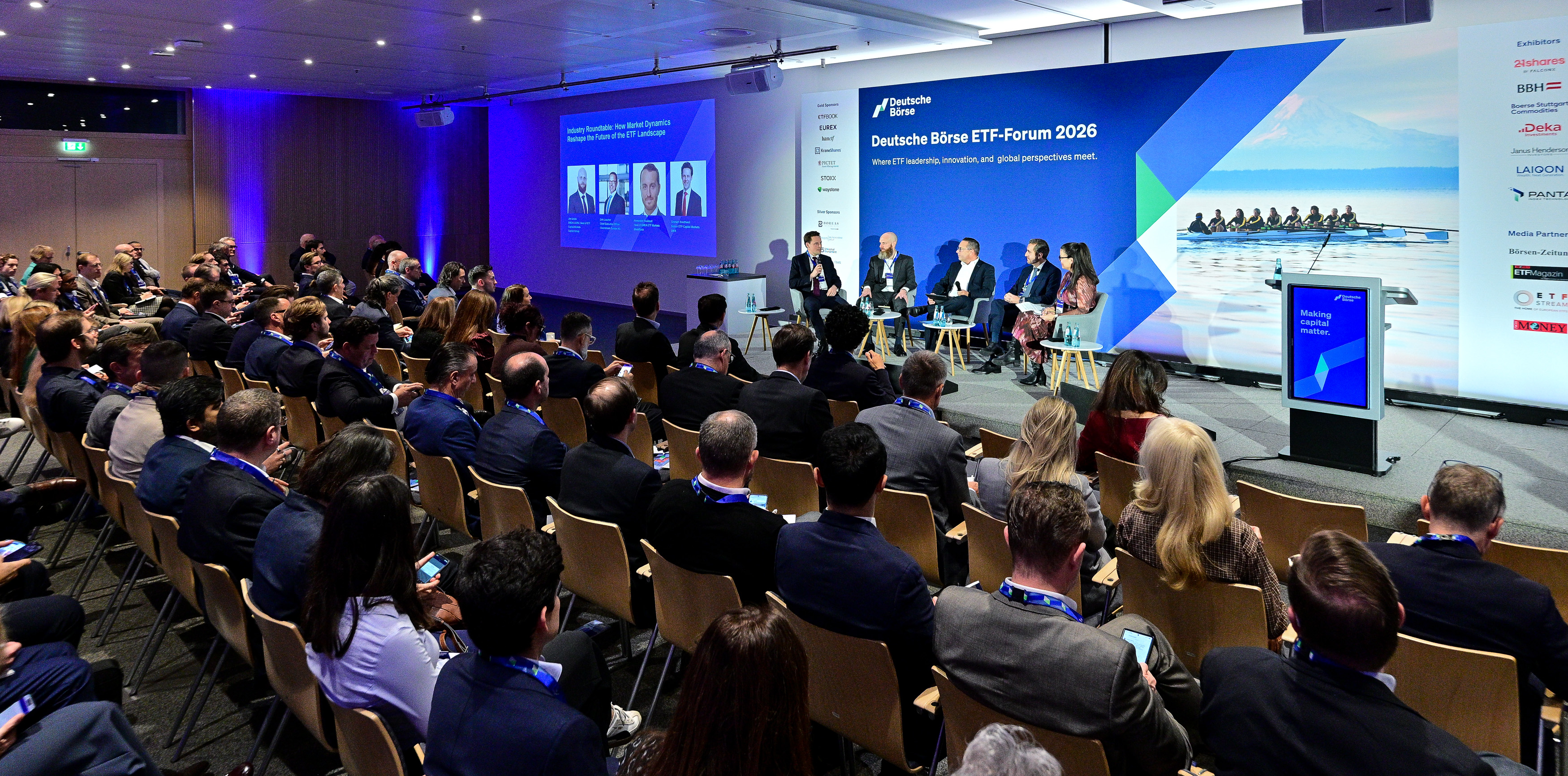
Somewhere in Germany, at this very moment, a 29-year-old woman is setting up her first ETF savings plan—with this image, Eric Leupold, Head of Cash Market at Deutsche Börse Group, opened the Deutsche Börse ETF-Forum 2026 in Frankfurt.
More than 500 guests had gathered, about 100 more than the previous year. What stood out was not only the number but also the composition: The audience was significantly more international than in previous years, with many foreign issuers and investors in attendance. This reflects a remarkable internationalization of the ETF industry in Germany. The rapidly growing number of providers that have entered the market in recent months is a clear sign of this trend. The reason is obvious: The German retail market is one of the most exciting and progressive in Europe.
Records on Deutsche Börse Xetra
Leupold backed this up with figures. With its 3,000th ETF, Xetra reached a new all-time high in listings. Retail investor orders totaling over 9.6 billion euros have been executed via Xetra Retail since its launch—an initiative offering better price quotes and extended trading hours. Nearly half of this volume occurred during core trading hours with price improvements.
Since December 2025, trading has taken place from 8 a.m. to 10 p.m.; in the first nine months of 2026, 21 percent of retail volume was already accounted for by the new extended trading hours. The number of ETF savings plans in continental Europe has increased sixfold to more than 15 million in five years—with Germany being the most dynamic market.
Retirement Savings Accounts: Tailwind from Legislators
Government plans for retirement savings accounts are likely to further fuel this trend. Leupold called the Retirement Savings Reform Act the most significant reform since Riester: Starting January 1, 2027, ETFs will, for the first time, play a fixed role in government-subsidized retirement savings. During the panel discussion, Sören Ganz (flatexDEGIRO) and Patrick Diel (DWS Xtrackers) predicted an 80:20 ratio in favor of simple ETF solutions in the online channel—while the ratio is likely to be the reverse in traditional distribution channels. Dr. Norbert Kuhn (DAI) would like to see a single ETF account structure that grows with the investor, from early-retirement pensions to employer-sponsored retirement plans.
Retail is Changing Trading
The industry roundtable featuring Jim Goldie (Capital Group), Dirk Loscher (Clearstream Europe AG), Alex Roubaud (BlackRock) and Graham Southwell (Xtrackers) demonstrated just how strongly retail investors are already shaping the market. On days when German savings plans are executed, the average order size in the order book drops by 25 percent. Nevertheless, the retail share of European ETF trading stands at only about 15 percent, compared to about 45 percent in the U.S.—leaving plenty of room for growth.
Active ETFs: Fund Management in a New Package
Another growth driver is the rise of ETFs relative to traditional mutual funds, which are increasingly being launched in ETF form themselves. Ruairidh Hill, CFA (J.P. Morgan AM) and John Mullins (PIMCO) illustrated the scale of this trend: In the U.S., active ETFs account for about 13 percent of ETF assets, while in Europe they account for less than 4 percent—yet one in four new issuances is already active. Mullins sees opportunities particularly in bonds because central banks, insurers, and index funds do not trade primarily based on price, which creates inefficiencies. For fund selectors, a fifth “P” is added to People, Philosophy, Process, and Performance: Platforms—the provider’s trading and capital market infrastructure.
Macro: Moderate Growth, Stable Prices
In the macro panel, Freya Beamish (TS Lombard), Daniel Morris (BNP Paribas AM), and Christian Schulz (Allianz GI) agreed: The eurozone has inflation under better control than the U.S., but growth remains moderate.
AI: Value Creation Is Becoming Physical
Dr. Florian Heinemann, founder and partner at Project A Ventures, offered a sober perspective on the AI hype in his keynote address. Venture capital follows a power-law distribution: At Project A, five out of approximately 160 investments account for over 90 percent of the portfolio’s value. The major language model providers lack genuine network effects, and Chinese open-weight models are only a few months behind. Simple software subscriptions are coming under pressure as customers need fewer licenses thanks to AI. Heinemann sees Europe’s opportunity in deep tech, robotics, and defense technology: if robots take over the majority of manufacturing, local wages will also become competitive again.
The panel featuring Tobias Marcks (Siemens Energy), Michael Stewart, CFA (Amundi), and AJ Ziegler, CFA (BlackRock) highlighted where the AI economy is reaching its limits. The bottlenecks are physical: gas turbines are fully booked industry-wide for five years, and only three manufacturers worldwide supply high-performance memory chips. In the transition to “Physical AI”—robotics and autonomous industrial machines—Europe is well-positioned thanks to its mechanical engineering and manufacturing expertise. Regarding thematic ETFs, Stewart called for high revenue purity: the index should include only companies that actually generate revenue from the specific theme.
Conclusion
The 2026 Deutsche Börse ETF-Forum demonstrated that the German ETF market is international, growing rapidly, and receiving a significant boost from retirement savings accounts. ETFs have long since become more than just index products—they are becoming the backbone of wealth accumulation and retirement planning.
Photo: © Martin Joppen